US National Debt Tops $40 Trillion for First Time
The US national debt surpasses $40 trillion for the first time, arriving months earlier than forecasters expected as deficits and interest costs climb.

Key takeaways
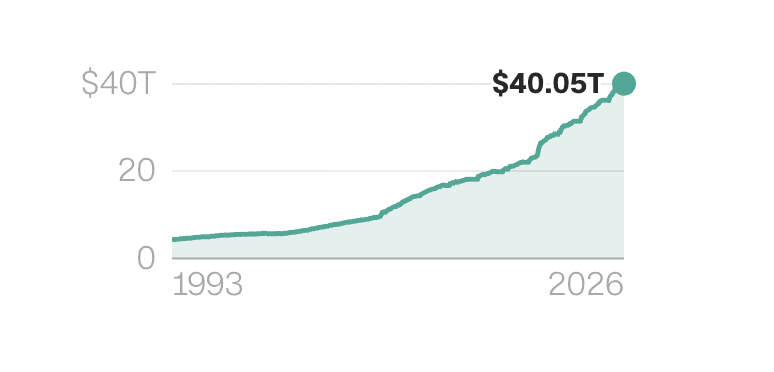
- The U.S. Treasury confirmed total public debt outstanding surpassed $40 trillion in August, just five months after the debt crossed $39 trillion in March.
- Annual interest payments on the debt topped $1 trillion for the first time in fiscal 2025 and are projected to more than double by 2036.
- Lost tariff revenue after the Supreme Court struck down several of President Trump's tariffs contributed to the debt hitting $40 trillion earlier than forecasters had expected.
What happened
The U.S. Treasury Department confirmed that total public debt outstanding surpassed $40 trillion in August, a milestone that arrived months earlier than many forecasters had expected. The figure marks a roughly one-third increase in total debt in less than five years, driven by persistent federal budget deficits.
The debt reached $40 trillion just five months after crossing the $39 trillion mark in March, and five months before that, it had passed $38 trillion in October, reflecting an accelerating pace of borrowing over the past year.
Why it matters
The milestone highlights the growing strain that interest payments are placing on the federal budget, with annual net interest costs topping $1 trillion for the first time in fiscal 2025 and expected to more than double to roughly $2.1 trillion by 2036, according to Congressional Budget Office projections.
Fiscal watchdogs warn the rising debt load is already affecting everyday Americans by pushing up borrowing costs for mortgages, auto loans and other forms of consumer credit, as investors demand higher returns to hold U.S. government debt amid concerns about the country's long-term fiscal trajectory.
Evidence and context
The debt hit $40 trillion sooner than expected in part because of billions of dollars in lost tariff revenue after the Supreme Court struck down several of President Trump's tariffs, forcing the Treasury to refund more than $100 billion in import taxes that had been collected. The government has continued spending well beyond its tax revenue, borrowing $1.8 trillion in the first ten months of fiscal 2026 alone, more than it borrowed in the entirety of fiscal 2025.
For perspective on the scale involved, the national debt took nearly two hundred years to reach $1 trillion for the first time in 1981, but has now doubled in just the past decade, rising from just under $20 trillion in August 2016 to $40 trillion today.
Unsustainable borrowing on this scale has huge repercussions throughout the economy.
— Maya MacGuineas, president of the Committee for a Responsible Federal Budget
The people and places affected
Broken down per person, the $40 trillion debt load works out to roughly $117,000 for every American, based on current Census Bureau population estimates, a figure fiscal policy groups have used to illustrate the scale of the burden facing future taxpayers.
The Social Security trust fund, which faces potential insolvency as early as 2032 to 2033 according to some projections, adds another dimension to the debt debate, since addressing the program's long-term shortfall would likely require either benefit changes, tax increases, or a combination of both.
The open questions
The central question facing policymakers is whether Congress will take any concrete steps to address the widening deficit, with fiscal watchdogs like the Committee for a Responsible Federal Budget calling for a commitment to no new borrowing as a starting point, alongside a longer-term deficit target relative to GDP.
It also remains to be seen how the growing debt load will affect the Federal Reserve's policy decisions, given that rising deficits and higher Treasury issuance can themselves put upward pressure on interest rates independent of the central bank's own actions.
What comes next
The debt is projected to keep climbing at a rapid pace, with the Peter G. Peterson Foundation estimating the total grows by nearly $7 billion each day under current fiscal policy.
Attention now turns to whether the upcoming December government funding deadline and any subsequent budget negotiations will include measures to address the deficit, or whether the debt will continue accumulating largely unaddressed heading into next year.
Olivia Brooks
Olivia Brooks covers the economy, financial markets and the changing world of work. She explains what shifts in prices, borrowing costs and business activity mean for households.
More from Olivia